
Family business
A buyer research tool for a family olive mill
We built Buyer Scout for our founder’s family olive mill. It researches possible buyers of its olive oil abroad, one by one, and keeps the source of every fact.
The project at a glance
- For
- Our founder’s family olive mill in Boeotia
- Built
- 29 July 2026 to 8 August 2026
- Screens
- Three: the list, the buyers and one page per buyer
- Built with
- Next.js, TypeScript and SQLite on the user’s own computer, with the Anthropic API for the research steps.
- In use
- The mill’s sales tool
What it does
You choose a market, and the tool builds an Excel list of possible buyers there: importers and shops. For each buyer, it finds which olive oils they stock and at what price, works out what they likely pay themselves, who supplies them today and whom to write to, with an email address that has been checked.
It also notes what helps a sale, such as whether they sell oil under their own label and how they take on new suppliers. Finally it scores each buyer on how well they fit the mill, which uses it as its sales tool.
Before, the research was done by hand
The mill kept it in an Excel file with three sheets: the buyers in order of priority, the oils on their shelves with prices, and market reference prices.
Now the tool builds the list for the market you choose, does the same research on every buyer, and keeps every contact with the buyer in one place.
Three screens and no tabs
There are three screens on purpose, and none has tabs. The first is where the list comes in: the tool builds the Excel file for the market you choose and matches its columns to its own fields. Whatever you write in the list yourself counts as correct, and research never changes it.
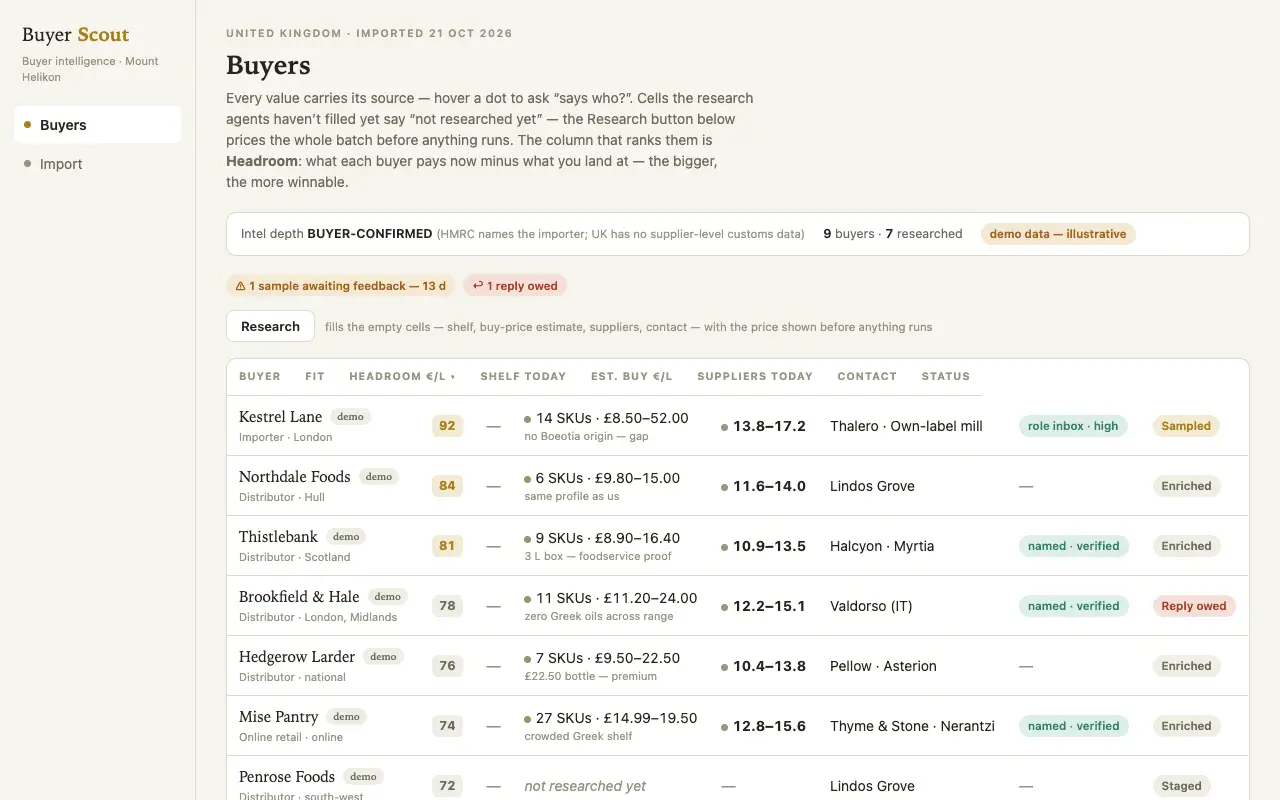
The second, Buyers, is the table at the top of this page: one row per buyer, with how well they fit, the oils on their shelf, what they likely pay, their suppliers, the contact and the stage. Above it is a count of what is waiting on you, such as a sample with no reply.
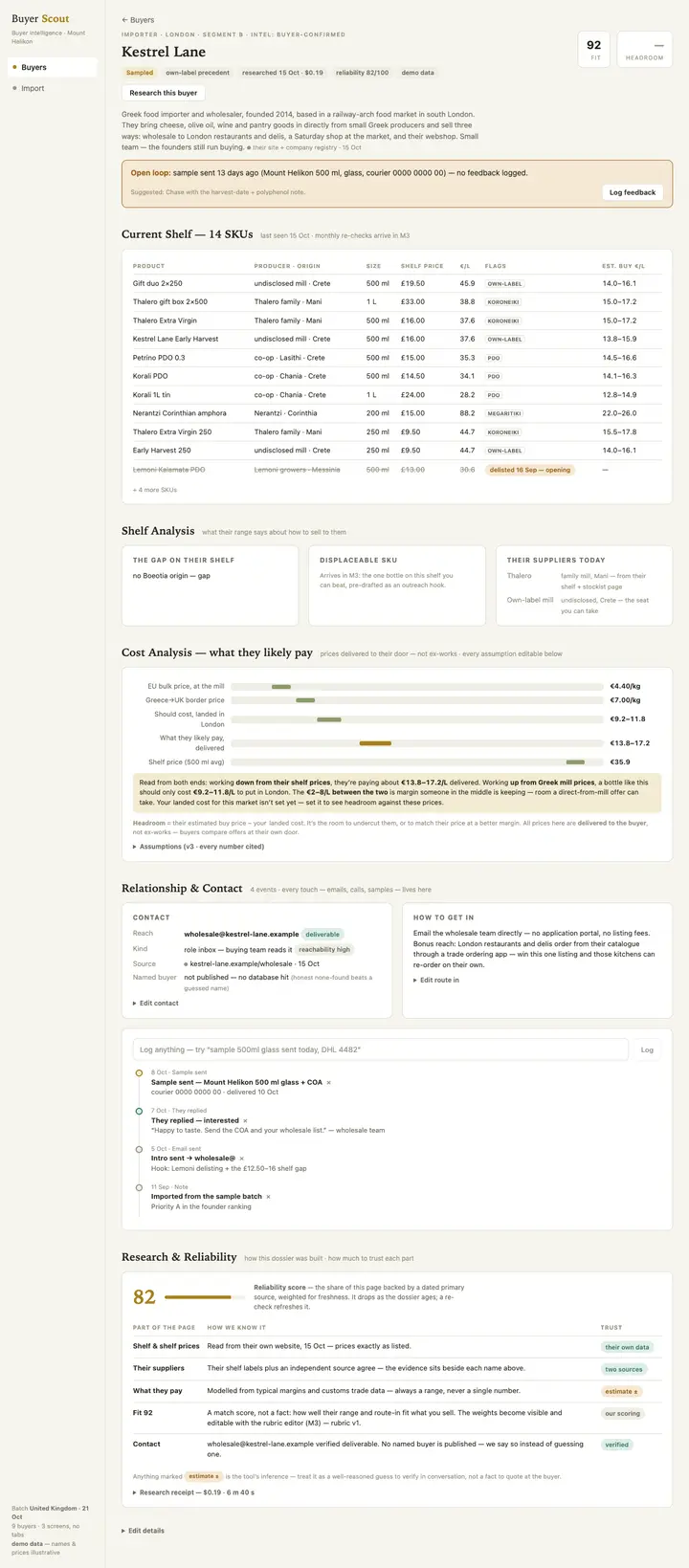
The third is one page per buyer. At the top is their file: what they stock, what they likely pay, who supplies them, the contact and how to approach them. Below is one timeline with every email, call and sample. Anything left open, such as a sample sent with no feedback, is pinned to the top as the next step.
A source on every fact, a price before every run
Every fact the tool finds keeps the address of its source, the date and how confident it is. So for every fact you can see where it comes from.
What a buyer pays is always given as a range with the assumptions beside it, never as one exact number. The tool works it out from both ends: down from the shelf price, taking off the usual margins, and up from bulk olive oil prices, adding the cost of getting to the shelf.
It runs on the user’s own computer, with no server and no accounts. The steps that use a language model are charged through the Anthropic API; the rest run free. Before a research run starts, it shows what it will cost in dollars and takes a limit. At the limit the run stops and never goes over.
To read shelves, it opens shop pages slowly, on purpose. If a site blocks it, the tool marks it for a person to look at and does not try to get past.
What it leaves out, on purpose
It sends nothing to buyers; it records what you sent. It has no automated email sequences, no compliance steps and no order management. The rule from the start was that nothing new ever arrives as another tab.
It works for one user on one computer and has no phone version: the buyer page needs a computer screen.
What we learned
In the first mockup, on 28 July 2026, the buyer page packed a lot into columns side by side and was hard to read. And the column with the price margin was called the “wedge”, a term that meant nothing to the mill.
The page became full-width sections, one under the other, with clear titles. The term became “Headroom”, with its definition beside it: what the buyer likely pays, minus what it costs the mill to get the oil there.
The last change, on 8 August 2026, fixed 12 faults that a second review of the research steps had found.
offplanathens.com, our own project with a WhatsApp inquiry path